
















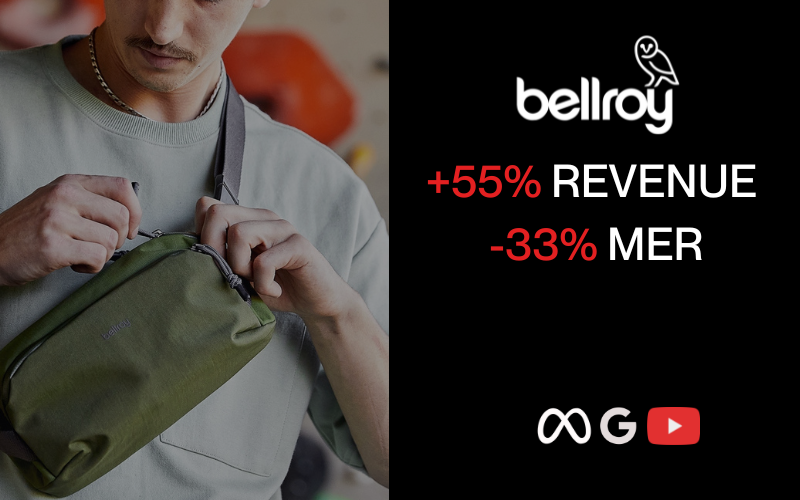


Great products don't stall. Their marketing does.
We see the same issues repeat across the category:
- Performance agencies optimise for the cheapest click, and the design premium quietly erodes
- Creative shows the product and the price, never why it was designed that way
- Founders are told to choose between the 'brand' ad and the 'performance' ad
We build both from one plan.
REQUEST YOUR GROWTH DIAGNOSIS -->

brands grow
Find what's actually capping growth: the acquisition model, the tracking, or the mix between brand and performance.
Turn what makes your product special into a brand system that sells online, built for the buyers who aren't ready yet.
Creative that tells the design story, tested in market and fed back into every campaign.
Words from our clients


.svg)


Are We The Right Fit? | Frequently Asked Questions
What's the difference between brand strategy and performance marketing?
Performance marketing targets the small share of an audience ready to buy today. Brand strategy builds recognition and trust with everyone else, so they choose you once they are ready. Most brands over-invest in the first and starve the second, which is why growth stalls even when ad accounts look healthy.
Do I need brand marketing or performance marketing?
If your acquisition cost keeps climbing and reporting can't explain why, that's usually a brand problem showing up as a performance metric. If you don't yet have consistent creative, positioning, or story, fix that before adding media spend.
What is digital brand transformation?
Digital brand transformation is the process of turning a brand's product insight or traditional marketing approach into a structured brand system, positioning, creative territories, and campaign execution that enables rapid online testing that compounds.
Can one agency do both brand strategy and performance marketing?
Yes, but most don't, because they're built as separate disciplines with separate teams. Intentional runs both under one method so brand and performance work off the same positioning instead of competing for budget.
How much of my marketing budget should go to brand versus performance?
While a brand is seeking product-market fit, it's normal for 90%+ of spend to go toward the short term. That's because you're chasing the 5% who are ready to buy, to confirm you can scale. This typically gets a brand to around $1M USD in annual revenue.
Depending on the brand and category, you may be able to continue down the performance-only path while harvesting that short-term demand. Typically, brands hit their first performance ceiling around $3M-$10M in annual revenue.
If you're experiencing that ceiling, moving just 20% of budget toward brand is recommended.
Recommended reading: The Long and the Short of It (Les Binet & Peter Field) and How Brands Grow (Byron Sharp).
Who is Intentional for?
Founders and marketing leaders of product design brands, typically $3M to $30M in revenue, whose growth has plateaued and who need a brand and creative system built, not just more ad spend. We work with brands in Australia and worldwide.
What should I ask an agency to see, beyond their portfolio?
Ask an agency to walk you through a case study that starts with a business problem, not a design output. A strategic partner starts with understanding why growth stalled before anyone touches a mood board.
Should brand, creative, and media buying be one team or separate agencies?
When brand identity and performance media sit in separate agencies, the brand story tends to get lost in translation, and top-performing creative rarely feeds back into what the media buyers actually test. Ask how an agency keeps brand and performance talking to each other, or find a partner who runs both under one roof.
What should happen before an agency scales my ad spend?
A real growth partner looks at CAC, margin, and LTV before recommending more ad spend, not after. Be wary of anyone ready to “scale” on day one, before that work is done.
Who will I actually be working with?
The people you meet in the pitch are the people who do the work. There's no bait and switch at Intentional: you won't be handed to a junior team once you sign. You get direct access to a senior team who understand your business, week to week.